Support for International Students
International students and scholars have always faced challenges and precarity on account of their status as visa holders. This is especially true under the current presidential administration. This precarity can cause stress, concern, and uncertainty for international student workers.
International graduate student workers can gain increased security and support by unionizing and negotiating for additional protections. Some examples of gains made by international academic workers at other universities include:
- UW grad workers, postdocs, and researchers (UAW 4121) won rights for international workers including paid leave for immigration appointments and hearings plus the right to reappointment if someone loses work authorization.
- Harvard student workers (UAW 5118) established a $100,000 annual fund for international student workers to use toward costs associated with immigration and maintenance of legal working status in the United States.
- University of California Postdocs (UAW 5810) won increased rights for international postdocs by ending UC’s practice of denying health benefits for many international postdocs and ensuring equal treatment regardless of immigration status.
- Columbia student workers bargained for and won rights for international student workers, including paid leave for immigration appointments, arrangements for remote work if one cannot return to the US for reasons outside their control, and guaranteed support from immigration attorneys for visa issues.
- Here is a summary of international student-specific benefits and protections that have been won by graduate student worker unions around the country.
- Here is an article from an international grad worker at Pitt, who reflected on the importance of unions for international graduate student workers.
On a broader scale, UAW has also been a critical resource and provided a political voice for international students and scholars to affect national policy. UAW academic workers have::
- Created resources for international scholar members including a free hotline staffed by immigration attorneys, FAQs and know-your-rights webinars.
- Organized and won new protections including a legal support fund at the University of California.
- Supported litigation against the Trump administration’s policy of arresting and deporting workers for protected speech (AAUP vs. Rubio).
- Filed an amicus brief in support of litigation (Svitlana Doe v. Noem) challenging the Trump administration’s end of the TCHNV parole program that allows certain immigrants from Cuba, Haiti, Nicaragua, and Venezuela to be lawfully in the United States with a right to work.
- Lobbied Congress to support bills in Congress expanding visa and green card access and to oppose efforts targeting Chinese students and scholars.
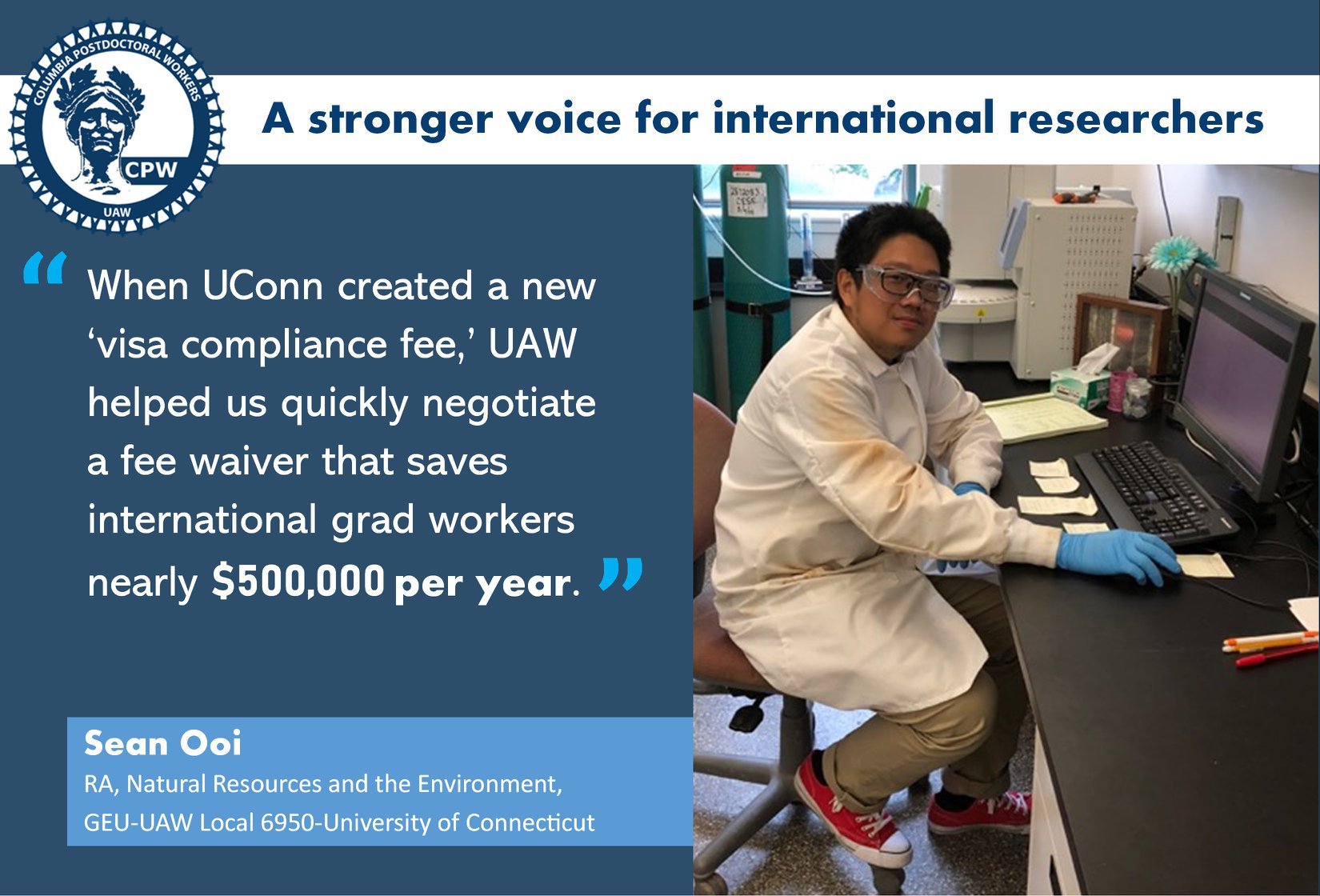

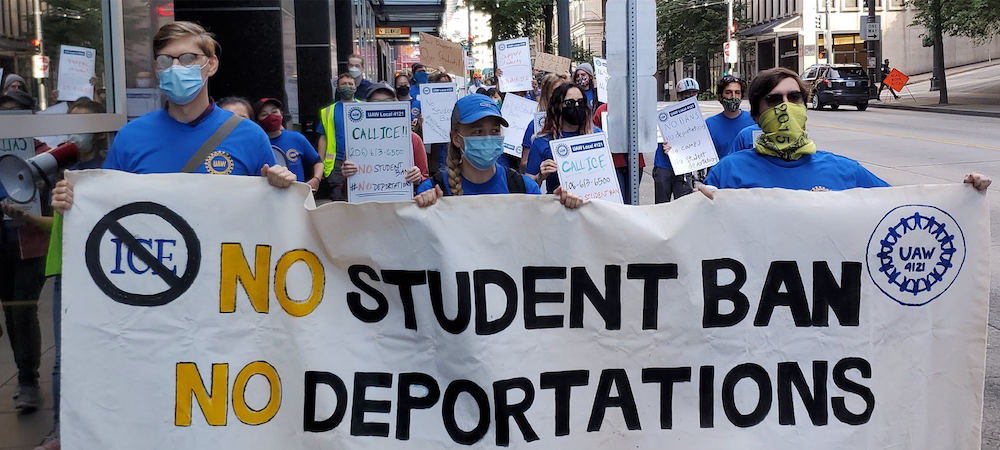
In October of 2020, UAW Academic Workers mobilized against a proposed rule by ICE to shorten visa stays for international scholars; thousands of public comments were submitted, including by the President of the UAW International. In July of 2020, thanks to the direct action by UAW Academic Workers across the country, in addition to efforts by our university and government allies, ICE backed down from its directive to deport international students taking online classes due to COVID-19. In 2017, the UAW International filed an amicus brief in the Supreme Court case challenging the Trump administration’s travel ban.

UAW 2865 and UAW 5810 members protest outside of ICE offices in San Francisco, summer 2020
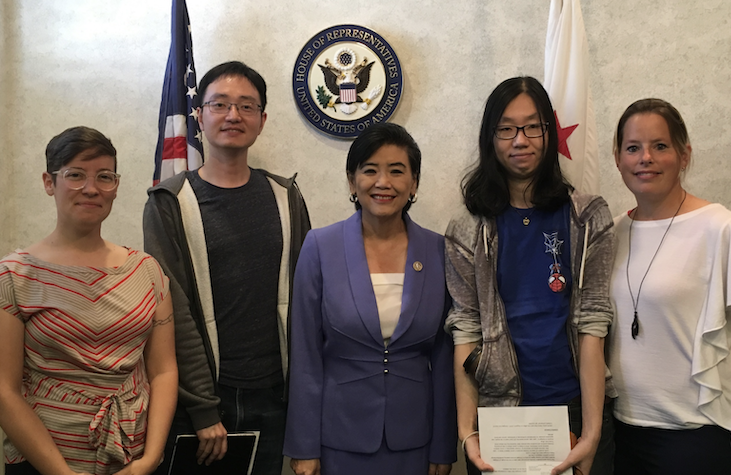
UAW Local 2865 and UAW 5810 union members with Congresswoman Judy Chu discussing her Dear Colleague Letter in support of Chinese international students at her office in Pasadena, 2018.
Nationally, the UAW represents more than 100,000 workers in higher education, a powerful force for effective lobbying. Working with members of Congress, UAW academic workers helped win the Optional Practical Training STEM extension. UAW Locals 5810, 2865 and 4121 representing Postdocs and Student Workers in Washington and California also worked with Congressional Representatives Judy Chu and Pramila Jayapal on a Dear Colleague letter demanding that Secretary of State Pompeo restore the validity period of Chinese international students’ entry visas from 12 months back to 60 months.
International Student Worker Frequently Asked Questions
Your Title Goes Here
Your content goes here. Edit or remove this text inline or in the module Content settings. You can also style every aspect of this content in the module Design settings and even apply custom CSS to this text in the module Advanced settings.
Can international students join a union?
Yes! International student workers, as employees of a US institution, are protected under federal law in the same ways that domestic student workers are. This includes freedoms of expression and association (which includes unionization, organizing, striking, etc.). The National Labor Relations Act (NLRA), which ensures our right to organize, does not differentiate between citizens and non-citizens. Its statutory protections are equal to all covered workers, regardless of their status as immigrants to this country.
This means you can:
-
Talk about your working conditions with your coworkers, the public, the media, or a union.
-
Organize with your co-workers improve your working conditions.
-
Join a union or help form a union.
-
Help a union bargain for a contract to set your wages and other conditions of work.
What are my rights during union organizing?
Under the NLRA, you have the right to organize a union to negotiate with your employer over your terms and conditions of employment. Your rights to do so are identical to domestic workers. This means you can distribute union literature, wear union buttons, t-shirts, or other insignia, solicit coworkers to sign union authorization cards, and discuss the union with coworkers. Here are some additional resources about your rights to organize. These legal rights mean that:
-
You cannot be fired, disciplined, demoted, or penalized in any way for engaging in these activities.
-
Your employer cannot prohibit you from talking about or soliciting for a union or from distributing union literature.
How can unionization support international students specifically?
Besides improving conditions like pay, healthcare, and working conditions, graduate student unions have made specific gains for international students.
For example:
- UAW 4121 won rights for international workers including paid leave for immigration appointments and hearings plus the right to reappointment if someone loses work authorization.
- Harvard Graduate Students Union (HUGS-UAW 5118) established a $100,000 annual fund for international student workers to use toward costs associated with immigration and maintenance of legal working status in the United States.
- CalTech Grad Researchers and Postdocs United (UAW Local 2478) won $500 for international scholars to use toward visa fees, 7-day paid time off for visa proceedings and protections for international postdocs.
Will my visa be affected if I join a union?
No, visas are secured for international students as long as you maintain all the requirements of work authorization – unionization does not affect this.
It is your right to belong to a union; union membership cannot affect your current visa or visa application. The U.S. Citizenship and Immigration Services (USCIS) cannot ask you questions about your union membership or participation in lawful union activity. In addition, the Department of Homeland Security (DHS) recognized the importance of enforcing labor laws and signed an agreement with the Department of Labor (DOL) and other federal labor agencies, including the National Labor Relations Board (NLRB)—the agency that enforces the NLRA—to that effect. This agreement, also known as a memorandum of understanding (MOU), is meant to ensure that immigration enforcement does not interfere with the exercising of labor rights.
What have Trump’s executive orders changed about international student rights?
The Trump Administration has been aggressively attacking immigrant rights, which makes it more important than ever that international grad student workers have a collective voice where domestic and international workers can stand together for immigrant rights.
How do I learn more about my rights as an international student beyond unionizing?
The Asian Law Caucus provides this resource with FAQs about travel, visa applications, and other know your rights information for people on student visas.