
UMD GLU-UAW Platform: What are UMD grads fighting for?
Over the course of thousands of conversations with our coworkers and seeing what our unionized colleagues at our peer universities have won, the following issues have emerged as likely priorities when UMD agrees to meet us at the bargaining table. While these demands have been approved by the GLU Organizing Committee, they are tentative and subject to change. Once we have a recognized union, our platform will become Initial Bargaining Demands and will be voted on by all grads. Last updated 6/20/2025. You can also view this as a document by clicking here.
Living wages
- Minimum $45,000/year stipend for 12-month GAships.
- Guaranteed 4% COLA increase per year.
Many GAs take second (or even third) jobs, which prevents us from doing our best research and teaching. Fellowships are not processed or confirmed in a timely manner, and instead are issued in the first month of classes, when things like rent and other expenses are well overdue. Most GAs are 9 or 9.5 month appointments, and other unions have won guaranteed summer funding for all GAs.
- $26,568 = The current minimum stipend before taxes for UMD Graduate Assistants working 20 hrs / week for a 9 month appointment (2025, UMD Graduate School).
- $46,555 = MIT calculator after-taxes living wage in Prince George’s County for a single adult with no children. It’s roughly the same in Montgomery County and the District of Columbia, where many UMD grads reside.
We demand a minimum $45,000/year stipend for 12-month GAship and guaranteed 4% COLA increase per year.
Affordable Housing
- Subsidized, affordable graduate housing, such that the annual rent is no more than 30% of the minimum annual stipend.
Most GAs at UMD are rent-burdened, meaning they spend over a third of their income on rent. Many GAs also have several roommates well into their late 20s and 30s. Subsidized graduate student housing has long waitlists, consistent mice and cockroaches and heat/cooling problems, and is still not affordable for a studio or one-bedroom. The University of Maryland is subsidizing private management companies who are not providing adequate housing services, and we can use our power as residents and workers to demand better housing and living conditions. Nearly 70% of GLU members as of February 2024 are unsatisfied with their housing.
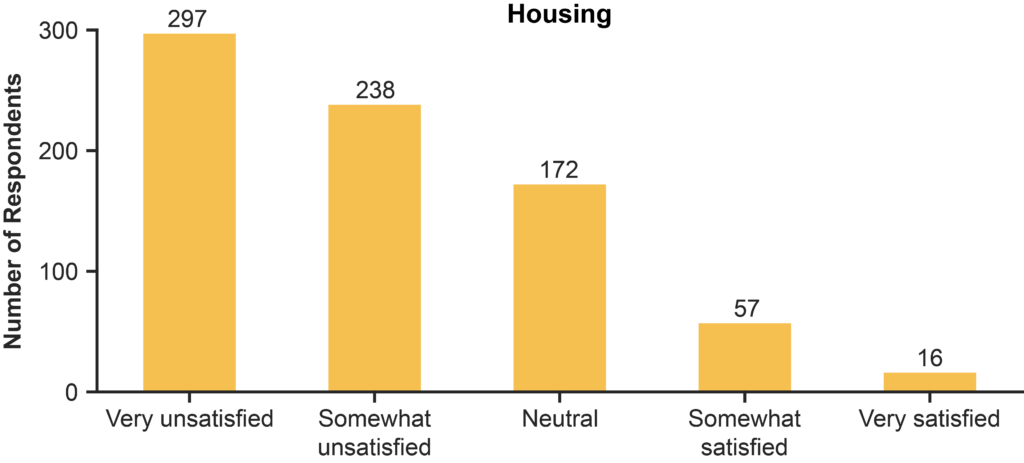
We demand that the University provides subsidized, affordable graduate housing, such that the annual rent is no more than 30% of the minimum annual stipend.
Enforceable Grievance Procedures
- Third party mediation from a neutral party unaffiliated with the university.
- A process for maintaining an assistantship and research progress if a GA is incapable or unwilling to continue under the supervision of an abusive supervisor.
- Transitional funding, which guarantees pay and benefits through any transition process triggered by a grievance procedure.
The current grievance procedure is opaque, bordering on invisible. There exists no current enforcement mechanisms, and involved parties, such as department chairs, are eligible to act as mediators. All of the power is held by professors and administrators. Together, we can amend grievance procedures to make them clear, fair, and enforceable, so that we can protect against harassment, discrimination, and abusive dynamics in the workplace. Third party mediation from a neutral party unaffiliated with the university would ensure protection against retaliation no matter if the grievance is reported anonymously or not. The grievance procedure should also include a process for maintaining an assistantship and research progress if a GA is incapable or unwilling to continue under the supervision of an abusive supervisor. We also demand transitional funding, which guarantees pay and benefits through any transition process triggered by a grievance procedure.
Legally Enforceable Employment Contracts and Job Security
- If any disciplinary actions by the University impacts a GA’s terms and conditions of employment, grads have the right to file a grievance.
- Adherence to ‘just cause’ standards to protect grad workers from arbitrary or unfair termination/disciplinary action.
- The right to a Union-mediated formal grievance process and the neutral, third-party arbitration described above if a worker feels they have been unfairly terminated or disciplined.
Currently, we have appointment letters and statements of mutual expectations which are not used consistently across departments or GAships and have no legal meaning. There are limited procedures around GA dismissal, with GAs often receiving limited to no warning about the suspension of pay and benefits.
The University should bargain with the Union in the event that any disciplinary actions by the University impacts a GA’s terms and conditions of employment, including, but not limited to: suspension, de-enrollment, limiting access to offices, labs, and other workspaces, limiting access to University digital infrastructure such as Canvas or Zoom, limiting access to campus, withholding pay, continuation of benefits such as healthcare, continuation of campus-run housing, and continuation of disability or parental accommodations. The University should also adhere to ‘just cause’ standards to protect grad workers from arbitrary or unfair termination/disciplinary action. In the case that a worker feels they have been unfairly terminated or disciplined, we demand the right to a Union-mediated formal grievance process and the neutral, third-party arbitration described above.
Regular Work Hours / Overtime Expectations
- Clear, fair policies around regular work hours and overtime expectations.
- 10 days of Paid Time Off + 10 Vacation Days in addition to university holidays.
- For positions which require work over university breaks (i.e. winter break), this should be stated in the offer letter and contract.
We are concerned with excessive teaching loads, expectations of working weekends or overtime without overtime pay, and other issues related to hours and schedules. A union would allow us to negotiate for clear and fair policies around workload and conditions that would also adapt to our diverse work practices. More than ⅓ of all GLU members as of February 2024 are unsatisfied or very unsatisfied with their work hours.
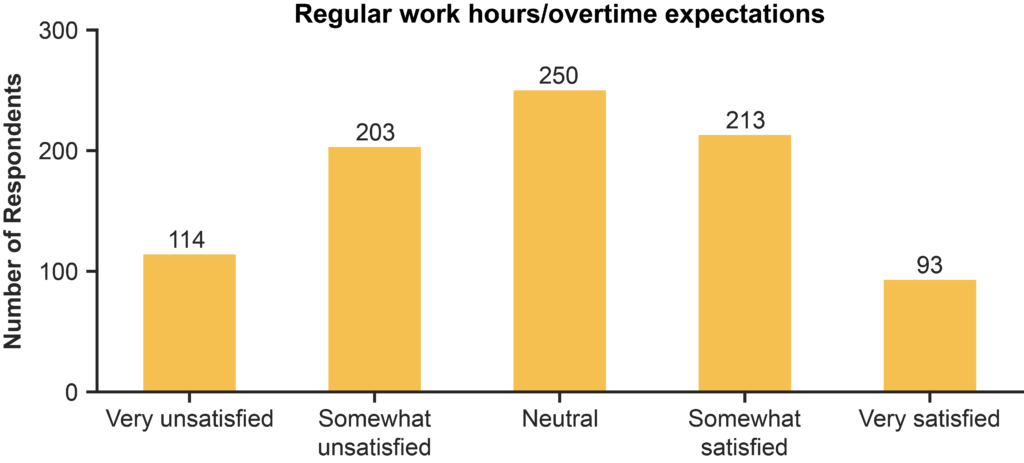
As a result, we demand clear, fair policies around regular work hours and overtime expectations; 10 days of Paid Time Off + 10 Vacation Days in addition to university holidays, and for positions which require work over university breaks (i.e. winter break), this should be stated in the offer letter and contract.
Equity for International Graduate Workers
- Abolish the inequitable $125 international student fee.
- Explicitly communicate the medical leave policy for international students.
- Guaranteed leave time (up to 40 days) for international workers to deal with any visa-related business.
- A fund of $40,000 per fiscal year to reimburse any costs that international graduate students incur to maintain their visa status.
- Guaranteed institutional support for students who are denied entry/deported, including financial support.
- Global/cross-cultural competency training to be available for advisors.
- If an international student has issues with visa renewal, their position should be held until the visa process can be completed, and they should be guaranteed the right to remote work if possible.
- If the University is not able to lawfully employ a graduate worker as a result of the worker’s immigration status, the University will make good faith efforts to re-employ the graduate worker as soon as legally possible.
1 in 3 UMD graduate students are classified as “foreign” / international (Bunsis, 2022, p. 50). International students cannot legally take a second job off campus, compounding issues raised earlier and forcing many into debt and/or exploitative employment situations on campus. International students are also required to pay an additional $125 in fees per semester. These fees are relatively new, having only been instituted in 2018, and the university has offered scant details as to how these fees are used. These fees compound with additional expenses that international students face, including costly visa application fees and particularly large security deposits on housing due to their visa status. For international students traveling from the Global South, where the local currency is likely to hold far less value than the USD, these extra fees and expenses can add disproportionate stress and impart a noticeable class disparity in UMD’s international graduate labor force. If UMD cares about diverse experiences, not just in terms of nationality but also global socio-economic status, then the administration should remove these unnecessary fees and provide more support for visiting foreign nationals.
Survey responses, included below, indicate that international students are overwhelmingly dissatisfied with their treatment by UMD administration.
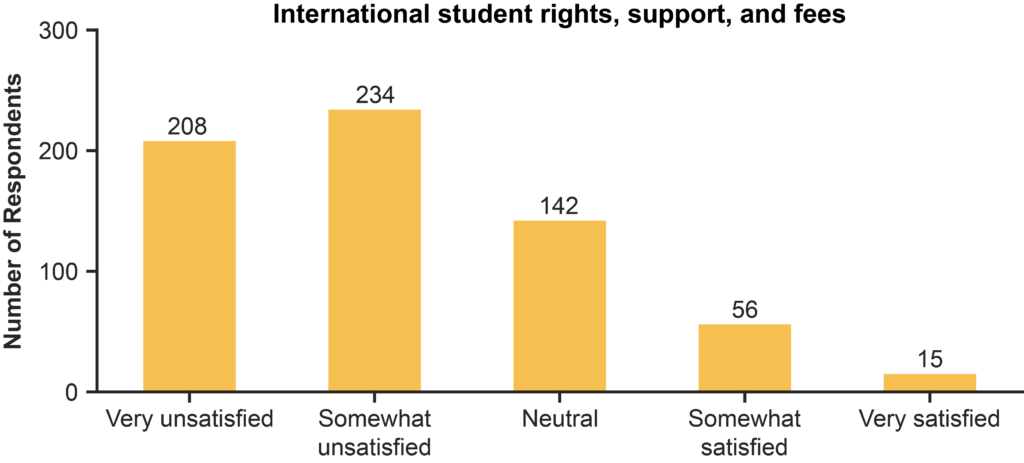
Other student worker unions have won legal aid, paid leave, options for remote work, waived fees, and other forms of support for international workers. We demand similar concessions from our administration:
- The University should explicitly communicate the medical leave policy for international students to both international students and their faculty advisors, department heads, and any other staff members that might advise on medical issues, as well as cover this information on the ISSS website and in both in-person student orientations/orientation modules and departmental staff/faculty meetings
- Guaranteed leave time (up to 40 days) for international workers to deal with any visa-related business, including any legal proceedings or for the purpose of traveling back to their home countries in order to renew their visas for themselves, their children, and/or their spouse
- A fund of $40,000 per fiscal year to reimburse, upon application, any costs that international graduate students incur to maintain their visa status, including any out-of-pocket legal expenses relating to visa and immigration proceedings and any related matters, including reimbursements for SEVIS and visa renewal fees
- Guaranteed institutional support for students who are denied entry/deported, including financial support, such as reimbursing flight costs and shipping costs for personal items
- Global/cross-cultural competency training to be available for advisors
- If an international student has issues with visa renewal, their position should be held until the visa process can be completed, and they should be guaranteed the right to remote work if possible.
- In the event a graduate worker is unable to report for work for an extended period of time due to an immigration-related matter, such as not being permitted to return to the United States, they will be permitted to perform the duties of their appointment remotely from outside the United States when practicable and permitted by law.
- If the University is not able to lawfully employ or continue to employ a graduate worker as a result of the worker’s immigration status, the University agrees to meet with the affected worker and the Union to discuss potential re-employment options once they are legally authorized to work. The University will make good faith efforts to re-employ the graduate worker as soon as possible after they obtain work authorization or immigration status lawfully permitting them to work.
- The University will furnish to any graduate worker who is terminated because they are not authorized to work in the United States of America, a copy of this Section of the Agreement.
Should any change in laws, regulations, or governmental policies (including, without limitation, through executive orders, agency directives, or judicial decisions) relevant to these procedures, including but not limited to repeal of DACA, rescinding of TPS, travel bans, or any other change in immigration law or regulations, or should a court ruling that sets forth any new interpretation pertaining to these procedures occur, then, at the union’s request, the parties shall meet to determine whether any adjustments to these procedures are necessary to comply with the new legal requirements. The University may need to comply with the law irrespective of its obligation to meet with the union.
University Protection from ICE
- The University will require that any federal immigration agent, Immigration and Customs Enforcement (ICE) agent, Department of Homeland Security (DHS) agent, or State and Local law enforcement officials must have valid judicial warrants (not administrative warrants) and verified credentials before entering university buildings or accessing records.
- When served with valid warrants, the university must immediately notify affected workers, provide legal rights information and emergency legal services, and inform the union within 48 hours.
The University will require that any federal immigration agent, Immigration and Customs Enforcement (ICE) agent, Department of Homeland Security (DHS) agent, or State and Local law enforcement officials comply with all legal requirements before they may be allowed to interrogate, search or seize the person or property of any worker.
Should an ICE or DHS agent request to enter a university building or obtain or review personnel records, the University shall: (a) verify the immigration agent’s credentials, (b) ask the agent why they are requesting access, and (c) request and verify a criminal judicial warrant signed by a federal judge. University staff shall not admit ICE agents into university buildings based on administrative warrant, ICE detainer, or other documents issued by an agency enforcing civil immigration law.
In the event that the University is served with a validly executed Search or Arrest warrant, the University shall: (a) immediately notify the affected graduate worker if legally permissible, (b) arrange for a questioning of the affected graduate worker to occur in as private a setting as possible in the workplace, (c) inform the graduate worker of their legal rights including the right to legal representation, and (d) provide access to emergency legal services through ISSS (e) notify the Office of General Counsel. Further, the University will notify the union within 48 hours if the University learns of an immigration investigation regarding a graduate worker.
University of Maryland Police Department (UMPD) shall not, beyond the extent expressly required by federal law: (a) inquire about or investigate the immigration status of any individual, (b) collaborate or assist with any immigration enforcement operations with ICE or other federal agencies, (c) utilize campus resources to support the operations of ICE or other federal law enforcement agencies, (d) enter into any agreement that would have UMPD perform immigration enforcement functions.
Campus Accessibility and Disability Justice
- Centralized accommodation funding from the Graduate School, not departments.
- Increased data and accountability on disabled graduate worker outcomes.
- Paid positions for graduate disability advocacy in Accessibility and Disability Services.
- Explicit accommodations for both work and classes and streamlined procedure for requests.
- Waiver to allow disabled grads to retain access to full-time status with fewer credit hours.
- Expanded healthcare coverage and disability-related mental health support/counseling.
- $100,000/year medical expense support fund.
Our union advocates for comprehensive reform in disability justice and accessibility across campus. Currently, there is a distinct lack of support for disabled graduate workers. Funding for accommodations comes out of department funding, not from the wider university, so departments are disincentivized to take on graduate workers with disabilities. We demand a centralized, university-wide accommodation fund to remove financial burdens from individual departments, paired with an independent Disability Advocacy Office to support graduate workers facing discrimination.
The Graduate School does not currently collect data on how many applicants self-disclose a disability, which leads to a lack of documentation for how many of those applicants are accepted, enroll, receive assistantships, complete their programs, and/or file discrimination complaints compared to nondisabled peers.
To ensure accountability, we call for data to be collected annually to evaluate the employment and experiences of disabled graduate students. This data should come from a wider survey of graduate workers that allows participants to disclose a disability if they choose to do so. Responses to survey items, and particularly disclosures of disability, must not be traceable to individuals.
Additionally, work done to increase accessibility/community and provide resources for disabled people on campus is almost always done by said disabled people and goes uncompensated; we demand paid positions for graduate disability advocacy work within Accessibility and Disability Services.
Currently, graduate workers only have access to accommodations as students, ignoring disabled graduate workers’ right to have necessary accommodations for their labor. We demand that the University of Maryland Disability and Accessibility Policy and Procedures (V1.100-(D)) be amended to explicitly include both academic and work accommodations for graduate workers. The graduate work accommodations procedure should be similar to that of faculty and staff and follow the same structure of Accommodation Request, Eligibility Determination, Accommodation Determination, and Implementation, including means of redress if accommodations are not being fulfilled. The graduate worker accommodation process should create a set of reasonable accommodations that will be applied to all paid positions a worker holds and can be adjusted at later dates if the worker’s support needs change. The accommodation plan must be agreed upon by the worker, their graduate advisor, the Graduate School, and an ADA consultant. The University must use good faith efforts to implement reasonable accommodations within thirty (30) business days of receipt of the required documentation for the requested accommodations.
Retaining access to university resources (health insurance, housing, assistantships, etc.) is dependent on maintaining full-time student status. The accommodation for “part time as full time” GAships provided by the Graduate School needs to be standardized and publicized, and new procedures need to be put in place to prevent departments/advisors from willfully revoking the full time status of disabled students without recourse. We propose a waiver that disabled graduate workers can apply for so that they may sign up for fewer credit hours and still retain full-time status. Students who get sick or need time off from burnout should be supported as long as possible so that they can sooner return to their duties.
We demand expanded health insurance coverage and support for disability-related needs, including more comprehensive mental health support, counseling specific to disability-related issues, and centralized, free or low-cost resources for disabilities. The University has been stripping back virtual and hybrid learning options and COVID-19 protections ever since the lockdown was lifted, demanding that anyone high-risk for illness, or those who struggle to navigate campus due to mobility/sensory issues, return to the “normal” classroom without regard for the accessibility-related consequences. Campus transportation should be reliable and flexible, with improved paratransit services and accessible routes throughout campus. Teaching spaces must maintain hybrid options and COVID-19 protections for high-risk individuals.
The other financial issues we face as graduate workers (poverty pay, expensive/insufficient insurance, lack of affordable housing, etc.) are exacerbated for graduate workers with disabilities by the “disability tax”—the increased cost of living faced by disabled people who need to pay for extra medical treatments, assistive devices, etc. To address financial inequities, we propose a medical expense support fund of $100,000 per fiscal year.The university should also provide subsidized, accessible housing options and cover the costs of assistive technology and accommodation-related equipment.
Finally, the other mental/emotional issues we face as graduate workers (abusive advisors, being overworked, etc.) are exacerbated for disabled graduate workers, who must often contend with their disabilities being used against them to portray them as “high-maintenance,” “lazy,” “making excuses,” or otherwise incapable of succeeding at their full potential. We therefore demand increased training for departmental staff/faculty and advisors on disabled workers’ accommodations and needs.
Subsidized Transit to and from Campus
- Subsidized access to public transportation (WMATA/Metro).
- Free parking passes.
- Access to faculty/staff lots on restricted gamedays.
Many graduate workers opt to live in locations farther from campus, given the high cost of living in the immediate College Park area. As a result, a significant number of graduate workers must use public transportation or drive to get to their place of employment. We demand fully subsidized access to public transportation (WMATA/Metro).
Parking passes should be free for graduate workers who drive to their place of work. In addition, many student lots are restricted during game days for paid parking. However, many graduate workers must come to campus on game days for their jobs, and are forced to pay for parking or otherwise park in lots that are incredibly inconvenient to their place of work. Graduate workers who drive to campus often live farther away, and do not have alternative, convenient public transportation options when they must come in to work on weekend game days, especially since commuter shuttles do not run on weekends. Therefore, we also demand access to faculty/staff lots on restricted game days for graduate workers.
Access to Subsidized, Quality Health Insurance, Family and Medical Leave Insurance, Parental Leave, and Childcare Subsidies
- Fully subsidized health insurance premiums for grad workers and their dependents.
- Access to the same state-sponsored health insurance program as full-time faculty.
- Compliance with the state Family and Medical Leave Insurance plan for all employees of the University of Maryland System, including GAs.
- 12 weeks of paid parental leave, in line with the policy offered to UMD faculty and staff.
- Annual subsidies ($6000) to alleviate the cost of childcare.
The University of Maryland Graduate Student Parental Accommodation Policy was recently amended to provide a period of up to eight (8) weeks during which new parents may postpone completion of academic requirements as of Spring 2024. However, this accommodation is not a leave, and GAs are still expected to work during the accommodation. Childcare costs are also a significant stressor for graduate workers who are parents, and UMD currently provides no guaranteed help for graduate workers who are also parents.
We demand fully subsidized health insurance premiums for grad workers and their dependents as well as access to the same state-sponsored health insurance program as full-time faculty. For graduate workers who are also parents, we demand compliance with the state Family and Medical Leave Insurance plan for all employees of the University of Maryland System, including GAs. We also demand 12 weeks of paid parental leave, in line with the policy offered to UMD faculty and staff, and annual subsidies ($6000) to alleviate the cost of childcare.
Trans Healthcare
- Maintain the Gender Affirming Care Program at the University Health Center at standards outlined by the World Health Organization/World Professional Association for Transgender Health.
- Ensure coverage of gender-affirming care and referrals for gender-affirming procedures through SHIP.
- Timely communication of changes to SHIP or the State of Maryland Employee Health Plan services, required authorizations, etc.
- Good-faith effort to lower access barriers for gender-affirming care and medications.
In order to maintain and improve the healthcare available for transgender and nonbinary graduate workers, the University shall:
- Maintain standards of gender-related care as outlined by the World Health Organization, regardless of the relationship of the United States to the World Health Organization, and the World Professional Association for Transgender Health.
- Maintain or improve the Gender Affirming Care Program at the University Health Center (UHC).
- Offer hormone replacement therapy (HRT) at the UHC for all ages of workers to the fullest extent allowed by law.
- Ensure that SHIP covers gender-affirming care to the fullest extent allowed by law.
- Create a referral process for gender-affirming procedures (facial feminization/masculinization, tracheal shave, chest feminization/masculinization) at the UHC for workers on SHIP.
- Negotiate with SHIP insurance providers to restore coverage if a gender-affirming care service or medication, previously covered by the provider, is denied.
- Communicate changes to SHIP or the State of Maryland Employee Health Plan to enrolled workers within 5 business days of the change taking effect; changes include change in insurance provider, drug formulary, and required authorizations for medications and procedures.
- Make a good-faith effort to negotiate with SHIP providers to lower access barriers to HRT, e.g. by selecting a provider which does not require letters of support for HRT or preauthorization for estrogen therapy.
Safe and Equitable Access to Workplace Environments
- All RAs and TAs should have access to designated office or lab spaces.
- Safe workspaces free from dangers, including chemical exposure, mold exposure, prolonged heat exposure, and more.
Physical conditions experienced by GAs at work include: broken air conditioning throughout the entire summer (Engineering building) and no windows or natural light. Further, GAs in some programs are currently not guaranteed office space on campus. All RAs and TAs should have access to designated office or lab spaces where we can do the research we are being paid to do or meet with the students we are teaching. Graduate workers should also have safe workspaces free from dangers, including chemical exposure, mold exposure, prolonged heat exposure, and more.
Standardized Tuition Remission and timely pay
- No matter a GA’s department, 20 hours/week should fully cover their tuition.
- All graduate workers should be paid in a timely manner with pay disbursed either as a biweekly paycheck or at the beginning of the term during which the assistantship occurs.
For some programs (e.g., Architecture), GAs working the maximum load (20 hrs / week) only receive remission for half of their tuition costs. No matter a GA’s department, 20 hours/week should fully cover their tuition.
All graduate workers should be paid in a timely manner with pay disbursed either as a biweekly paycheck or at the beginning of the term during which the assistantship occurs. In the event that there is a legitimate issue disbursing pay on time, the university should provide the pay to graduate workers in the form of a check or whatever is most expedient within two weeks of when the worker was supposed to be paid. The university should reimburse workers for late fees incurred as a direct result of the late payment of the worker’s wages.
Right to Free Speech, Peaceful Protest, and Protections from Retaliation
- Graduate employees should continue to have the right to engage in peaceful demonstrations and protests, regardless of citizenship status, and should not be met with force by the University or local law enforcement.
- Any graduate employee who exercises their right to free speech in a peaceful manner should not endure retaliation in the form of discipline or discharge.
Inclusive, nondiscriminatory workplace
- The University will not discriminate against any Employee based upon race, ethnicity, creed, caste, sex, gender identity or expression, sexual or relationship orientation, marital status, age, national origin, political affiliation, disability, religion, protected veteran status, genetic information, socioeconomic status, parental or pregnancy status, caregiver status, arrest or criminal record, or any other protected class or status.
- The University should refer to graduate workers by their chosen names and pronouns, and update all records and systems, including with external organizations such as the provider of the Student Health Insurance Plan, to reflect these preferences upon request.
- Dedicated lactation rooms for graduate workers who are nursing and publicly available list of lactation rooms on campus.
The University should not discriminate against any Employee based upon race, ethnicity, creed, caste, sex, gender identity or expression, sexual or relationship orientation, marital status, age, national origin, political affiliation, disability, religion, protected veteran status, genetic information, socioeconomic status, parental or pregnancy status, caregiver status, arrest or criminal record, or any other protected class or status.
The University should refer to graduate workers by their chosen names and pronouns, and update all records and systems, including with external organizations such as the provider of the Student Health Insurance Plan, to reflect these preferences upon request.
We demand dedicated lactation rooms for graduate workers who are nursing. If there is not an existing dedicated lactation room within a reasonable walking distance from a graduate worker’s workspace, the University should provide an informal, single-purpose space that is clean and free from intrusion from colleagues and the public for use as a lactation room. There should also be a publicly available list of lactation rooms on campus.